Detect revenue leakage, before the money is gone.
In our own production data, 5.2% of annual revenue leaks structurally, € 2.6M on a € 49.9M portfolio, through missed indexation, underbilling, duplicate invoices and side letters. GuardPilot finds it line by line, every night, with a reproducible trail per finding.
What is revenue leakage?
Revenue you are contractually entitled to, but which, through administrative drift, never reaches the invoice or is billed too low. Rarely fraud, almost always a pattern: the longer a contract runs without line-level control, the larger the accumulated gap. Our own production data (GuardPilot, 2025–2026: € 2.6M flagged on € 49.9M) puts this at 5.2% of annual revenue.
Where revenue leakage originates.
Missed indexation
A CBS, CPI or sector index is contractually agreed but is not applied each year, or applied too late. A single missed round compounds through every subsequent year.
Underbilling
Delivered hours, quantities or scope extensions do not fully reach the invoice. Usually visible as a structural gap between time tracking and the invoice line.
Duplicate invoices
The same deliverable lands on the invoice twice, via a second system, or a manual correction that never retracts the original line. Risky for the customer relationship and the revenue alike.
Unbilled work
Change orders, options or extra scope agreed verbally and never turned into an invoice line. The work is delivered, the evidence sits in email and tickets, not in the accounting system.
Forgotten escalation clauses
Contracts include tiers (for example, a tariff step or margin correction after year 2) that nobody activates when the trigger date arrives. The contract is clear; the trigger is missing.
Irregular billing cadence
A month skipped, two months doubled, a quarterly invoice that misses calendar months. The cash-flow impact is immediate; the revenue impact only becomes visible when the lines are reconstructed against the contract.
Side letters overruling the master agreement
Separate arrangements (discounts, exceptions, extra SLAs) that sit outside the main contract but are legally binding. They disappear the moment their author leaves, and then keep running silently, to the supplier's disadvantage.
A full line-level check, every night.
A team of agents runs a nightly cycle through contract, execution and invoice. Every difference is investigated, evidence is captured, and two independent models must agree before a signal reaches a human. No sampling, no alert fatigue, a reproducible trail per finding.
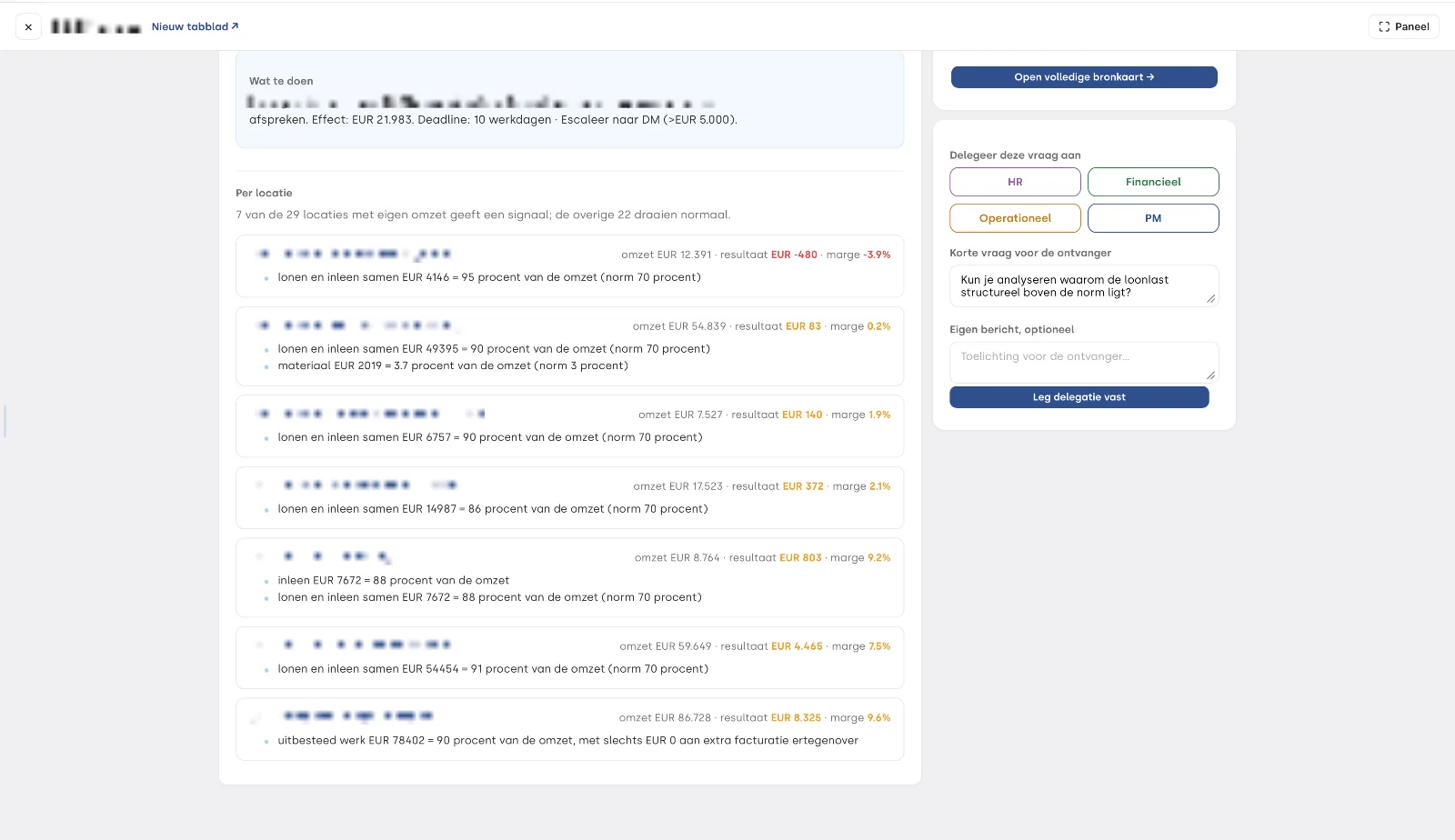
€ 2.6 mln in possible leakage flagged in March 2026.
About revenue leakage.
What is revenue leakage?
Revenue leakage is revenue you are contractually entitled to, but which never reaches the invoice or is billed too low. It arises from missed indexation, underbilling, duplicate or missing lines, forgotten escalation clauses, and side letters that overrule the master agreement. It is not fraud and rarely an incident, it is a structural pattern in contract-heavy portfolios that only becomes visible through a line-level comparison between contract, execution and invoice.
How much revenue leaks on average?
In our own production data (GuardPilot, 2025–2026), structural leakage sits at 5.2% of annual revenue: € 2.6 mln in possible leakage flagged in March 2026, on a € 49.9M portfolio. The pattern is always the same, the longer a contract runs without line-level control, the larger the accumulated gap: indexation stacks exponentially, and a single missed side letter runs on for years.
How do you find revenue leakage in contracts?
Manually it is practically impossible: one controller would spend months on a single portfolio and would work in samples by definition. GuardPilot does it at line level: a team of agents runs through contract, execution and invoice every night and compares them against each other. Every difference is investigated, backed by evidence, and confirmed by two independent models before it reaches a human as a signal. No sampling, no alert fatigue, a reproducible trail per finding.
What does detecting revenue leakage cost?
GuardPilot runs today on our own organisation and is available through a controlled waitlist; the first external pilots start autumn 2026. The pilot structure is deliberately outcome-based: you pay based on what is actually flagged as recoverable revenue, not on seats or document volume. We discuss concrete figures per case in the intake call, because portfolio characteristics (contract type, indexation methodology, billing cadence) drive the scope.
Want to know how much is leaking in your portfolio?
Request access to the waitlist for the first external pilots, or contact us for an intake call.
More of the GuardPilot system.
Contract monitoring
A team of agents reads along every night; 98.6% coverage where manual reaches 3%.
Contract audit
No sampling, 100% of the portfolio. Four-eyes principle, <4% false positives.
Invoice control
Every invoice against every contract. €23M invoicing-coverage proven in production.
AI in controlling
Not a stalled pilot, a human-in-the-loop system that already runs non-stop.